Thursday, May 13, 2021

_WEEK 14_ (FYP2)


Activity: Comparison of Results between Subjects. 


    After successfully collecting data in the previous week, I continued this week to do comparisons and analyses of the results acquired from the subjects.  All of their respiration rates have been presented on a line graph, as seen in the figure below, to assist me in analyzing and comparing the results.


    All of subjects are below 25 years old, female and mostly all in good health conditions. For adults in a state of rest their respiratory rate should be in between 12 until 20 beats per minute. So, basically, the respiratory activity of PUI cannot be measured during this time due to risk if the PUI are confirmed with COVID-19 positive. However, normal people’s respiratory rate has been measured as a reference so that comparison between healthy people and PUI who might develop early symptoms of COVID-19 can be done clearly. That is the greatest way to distinguish between normal and abnormal PUI breathing rates.

    Referring to the line graph also, shown that at 8:00 am in the morning and 12:00 am during midnight, the measured breathing rate is a bit lower compared to the others because at that time most people at rest. However, the breathing rate will be higher when the subjects do exercises, have a fever or are under stress. What can be observed from the data is that the respiration rate from subject 2 is higher than the others. Actually, subject 2 has a problem that her breath was short due to a few years ago she had undergone surgery to remove parts of her lungs as a result of her cancer cells spreading to the lungs. And she is also one of the bone cancer fighters. After the surgery, her doctor instructed her to do a breathing exercise to train her lungs to breathe as usual. While results for other subjects, everything is normal and within an acceptable range.

    Based on a few journals, the most common respiratory rate for PUI is basically over 20 breaths per minute (bpm) or also known as Tachypnea. According to the researchers, patients who suffered from COVID-19 diseases had a 91% mean oxygen saturation and 73% of the patients had a fever of 38 Celsius or 100.4 Fahrenheit. While 25% of the patients presented with cough. Yet only 10% of patients reported suffering from shortness of breath and the mean respiratory rate between them is 23 breaths per minute. However, the result of this E-mask project contributes to the definition of an individual's breathing rate, as well as their relationship to clinical and environmental parameters including medical history, gender, Body Mass Index (BMI), and age.

Friday, May 7, 2021

_WEEK 13_ (FYP2)


Activity: Collect data for the E-mask Results.


   As a result of the E-mask project, I obtained data from multiple students during this week. I was very lucky because at that time I was in the UniKL BMI residential college, and I was able to enlist the assistance of my friends by requesting them to serve as a sample for my results. Their breath readings were taken 5 times a day to monitor their breathing rate whether in a normal or abnormal range. Below is the example for my results:


Subject 1


    The first result was gathered by me. I am 23 years old. Based on the graph, at 8:00 am in the morning and 12:00 am during midnight, my breathing rate was 15 beats per minute (bpm). While at 12:00 pm in the afternoon, my breathing rate was 18 bpm. Then at 4:00 pm in the evening, my breathing rate was 16 bpm, and 17 bpm was my breathing rate at 8:00 pm in the night.

Subject 2

    The result above was obtained from subject 2, Aisyah. She is 23 years old. As shown in bar graph above, at 8:00 am in the morning, her breathing rate was 16 bpm. While at 12:00 pm in the afternoon, her breathing rate was 19 bpm. Then at 4:00 pm in the evening and 12:00 am during midnight, her breathing rate was 18 bpm. Finally, at 8:00 pm in the night, her breathing rate was 20 bpm. 


Subject 3

    The third data for this E-mask was collected from subject 3, Syukrina. She is 24 years old. Relate to the graph above, during 8:00 am in the morning, her breathing rate was 14 bpm. While at 12:00 pm in the afternoon, her breathing rate was 17 bpm. Then at 4:00 pm in the evening her breathing rate was 16 bpm. While at 8:00 pm in the night, her breathing rate was 15 bpm. While at 12:00 am during midnight, 13 bpm was recorded for her breath count. 


Subject 4

    The fourth data for this E-mask was acquired from subject 4, Balqis. She is 22 years old. As mentioned in bar graph above, basically, at 8:00 am in the morning and at 4:00 pm in the evening, her breathing rate was 13 bpm. While at 12:00 pm in the afternoon, her breathing rate was 15 bpm. While at 8:00 pm in the night, her breathing rate was 14 bpm. Lastly, at 12:00 am during midnight, 12 bpm was measured for her breath count. 


Subject 5

    The fifth data for this E-mask was gained from subject 5, Aqilah. She is 21 years old. As shown in bar graph above, at 8:00 am in the morning, her breathing rate was 15 bpm. After that, at 12:00 pm in the afternoon and at 12:00 am during midnight, her breathing rate was 17 bpm. Moreover, her breathing rate was 18 bpm at 4:00 pm in the evening. The 16 bpm was counted for her breathing rate at 8:00 pm during the night.


Subject 6

    Basically, the last data for this E-mask was achieved from subject 6, Auni. She is also 23 years old. Referring to graph above, during 8:00 am in the morning, her breathing rate was 13 bpm. In addition, at 12:00 pm in the afternoon and at 8:00 pm during the night, her breathing rate was 16 bpm. Then, her breathing rate was 15 bpm at 4:00 pm in the evening. Finally, the 14 bpm was examined for her breathing rate at 12:00 am during the midnight. 

    Generally, all the bar graph above accurately portrays value generated by the Blynk application for each subject. Referring to the graph above, as seen few outputs were collected in a day at 5 different times at 8:00 am, 12:00 pm, 4:00 pm, 8:00 pm and finally at 12:00 am. The purpose of taking at different times is to identify the difference in breath count at a time taken.

Friday, April 30, 2021

_WEEK 12_ (FYP2)


Activity: Briefing on Preparation Writing Technical Paper.


    On this week, the briefing was conducted via Microsoft Teams. Attendance of all FYP2 students is mandatory. They need to scan the QR code that has been provided and their attendance will be taken through Microsoft Team Attendance. The workshop was conducted by coordinator incharge, EN. MOHAMAD SHAIFUL BIN OSMAN. 


Date: 28 April 2021

Time: 2:30 pm – 4:30 pm

Via: Microsoft Teams


During the briefing, the coordinator have briefed us about:


Thursday, April 22, 2021

_WEEK 11_ (FYP2)


Activity: Briefing on Project Presentation & Technical Demonstration.


    Generally, during this week, the briefing was conducted via Microsoft Teams. Attendance of all FYP2 students is mandatory. They need to scan the QR code that has been provided and their attendance will be taken through Microsoft Team Attendance. The workshop was conducted by coordinator incharge, EN. MOHAMAD SHAIFUL BIN OSMAN. 


Date: 21 April 2021

Time: 2:30 pm – 5:00 pm

Via: Microsoft Teams


During the briefing, the coordinator have briefed us about:

Friday, April 16, 2021

_WEEK 10_ (FYP2)


Activity: 2nd Virtual discussion with Supervisor. 


    This week marks the 10th week of the semester. Due to the current situation that does not allow any physical activity to be held, so any discussion with supervisors related to the progress project will be held online, either by holding an online meeting via Microsoft Teams or WhatsApp's. The meeting started at 10:00 am and ended at 11:00 am. So, this week, my overall project, including both software and hardware, is almost complete. Virtual meeting with the supervisor this time is more useful to update the progress of the project. All project outputs are highlighted again to ensure that the project functions properly and that the project's objectives, which are to monitor the PUI's breathing activity and to display the PUI's breathing activity on a smartphone through the Blynk application, can be met. 

Friday, April 2, 2021

_WEEK 9_ (FYP2)


Activity: Prototype assembling & Final testing on the prototype for full operation.


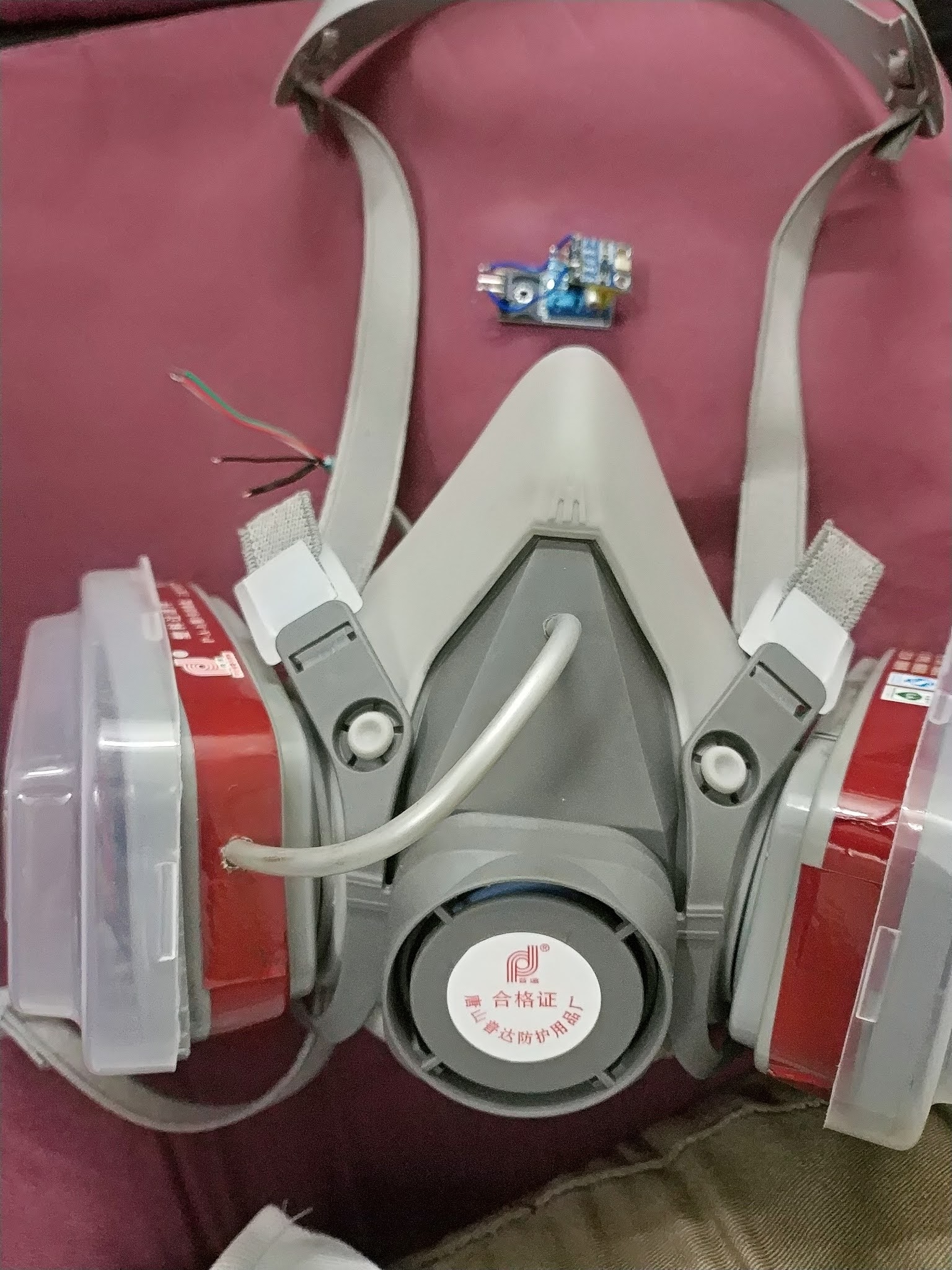
    As the ordered mask has arrived safely, the installation of the sensors has resumed. In fact, last semester me and my supervisor planned to use an N95 mask to produce this E-mask. Considering the wearer's safety, the appropriateness of the product, and the efficiency of the project, I've chosen to switch from the N95 mask to the Chemical / Dust Gas Mask. This is because the N95 mask feature is not very suitable to install the sensors. Among the reasons is that the N95 mask material is soft and sticks close to the face, which will cause discomfort to the PUI. 

    Besides, the sensor installed on the N95 mask will basically be in direct contact with the PUI face. Figure below shows the prototype of the project where all the circuit are installed inside the mask to make it more safe and secure. Even though this is just a prototype, the safety of the wearer should also be a priority. Furthermore, on the filter side of the mask, microcontrollers such as the ESP8266 and AA batteries have been attached. Everything fits well, and the components are neatly placed. After all of the installation work is performed, the project is tested to ensure that it functions correctly.


Inside view of the prototype:


Outside view of the prototype:


Complete hardware prototype for the project: 


    To conclude this week activity, the objective of this week is achieved. Full function of the prototype is also a success to this project. The desired objective of this project is necessary, and based on the discussion, it can be said that this "E-mask for COVID-19: Person Under Investigation (PUI)" project was a big success. 

Thursday, March 25, 2021

_WEEK 8_ (FYP2)


Activity: Thesis Writing Workshop.


    Generally, in this week, the workshop was conducted via Microsoft Teams. Attendance of all FYP2 students is mandatory. They need to scan the QR code that has been provided and their attendance will be taken through Microsoft Team Attendance. The workshop was conducted by guest speaker, EN. AHMAD SYUKRI MOHAMAD. 


Date: 24 March 2021

Time: 3:00 pm – 5:00 pm

Via: Microsoft Teams


During the workshop, the speaker have briefed us about:

  • Workshop on Chapter 4
  • Workshop on Chapter 5
  • Abstract Writing


    The workshop was intended to explain details about the thesis writing in chapter 4, chapter 5 & abstract properly. The student are required to write their thesis according to the content needed. Detailed explanations were given that day which greatly helped the students to complete their thesis. 

_WEEK 19_ (FYP2)

  Activity: Hardcover print & Complete Thesis Submission.      Generally, this was the final week for the progress report of my Final Ye...